One tool, one clearly drawn lane
Krisp for voice actors: where it fits, and where it doesn't
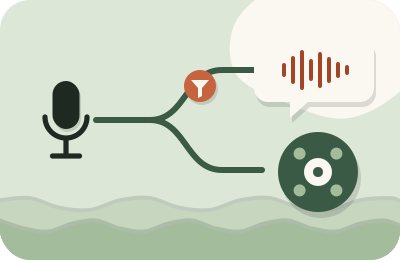
Krisp is real-time AI noise suppression that sits between your microphone and any call app, removing household noise before the other side hears it. For a working voice actor that maps to one precise lane: the live half of the job — directed sessions, agent calls, coaching, callbacks — and explicitly not your recorded masters. This page draws that line carefully, because a tool this good in its lane causes real damage outside it.
The problem Krisp actually solves for VO
Your recorded work forgives your room: you schedule takes around the dishwasher, and post-production catches what slips through. Your live work forgives nothing. A directed session runs at the client's hour, not your house's quiet one; the dog next door doesn't read call sheets; and the impression you make while discussing the read is part of the product. Live-session noise is a scheduling problem you can't schedule your way out of — which is exactly the shape of problem real-time suppression exists for. Krisp installs as a virtual microphone on your desktop: your call app (whatever the studio or client uses) selects “Krisp Microphone” as its input, and the suppression happens in the milliseconds between your mic and the call.
Where it fits: the live half, mapped
- Directed sessions. The director hears your read, clean, while the session runs at 2 p.m. against the neighborhood's full orchestra. Crucially, your DAW records the raw mic in parallel — suppression rides the call path only, so the delivered takes stay untouched for proper post.
- Agent and client calls. The business half of the career happens on calls, and audio-professional-with-audible-chaos is a brand problem. Suppression makes the room irrelevant.
- Coaching and classes. Long-form calls at household hours — the exact scenario where a fresh daily noise event (delivery, lawn care, children) is statistically guaranteed.
- Callbacks and live auditions. The highest-stakes minutes in the business, at times you don't choose. The full pre-call routine is in the audition audio guide.
Where it doesn't: your masters
Keep Krisp — and every real-time suppressor — out of the recording path for auditions, audiobook chapters, and deliverables. Three reasons, all structural. First, real-time tools optimize for call intelligibility under a latency budget; offline tools get to examine the whole file and work gently — an advantage no real-time system can match. Second, suppression aggressive enough to delete a household also thins room tone toward digital silence, and ACX's spec expects natural, continuous room tone at file boundaries and under speech; QA reads sterile floors as processing. Third, processing you record through is processing you can never undo — record raw and every option stays open forever. The correct division of labor, chain by chain, is in the software chain guide: suppression guards conversations, gentle offline reduction polishes files, and neither swaps jobs.
The professional configuration in one paragraph: call app input = Krisp virtual mic; DAW input = the interface directly. One microphone, two signals — the director hears suppression, the recording gets truth. Set it once alongside your gain staging and both halves of the job are handled permanently.
Call app input = Krisp virtual mic
The director hears suppression
DAW input = the interface, directly
The recording gets truth
Pricing, verified today
- 7-day free trial
- Core: $8/month, billed yearly
- Core: $16 month-to-month
- Checked 2026-09-20
Checked 2026-09-20, directly against Krisp's site: the pricing page now leads with a 7-day free trial and a Core plan at $8/month billed yearly ($16 month-to-month). The longstanding free plan — 60 minutes of noise removal a day — no longer appears on the pricing page at all; it survives only in Krisp's help-center documentation. Read that how it reads: unadvertised tiers are tiers on borrowed time, so if your plan is “use the free hour daily forever,” have a fallback. For evaluation, the honest path is the trial plus a real week of your actual calls.
Worth knowing before you commit: suppression runs on-device on the desktop apps (Windows/macOS) — your session audio isn't shipping to a server to get cleaned — and desktop is where the virtual-mic architecture lives. Evaluate on the machine you take sessions on.
The alternatives corner, honestly
If your machine has an RTX GPU, NVIDIA's Broadcast suite offers free real-time suppression of comparable ambition (hardware-gated, so it's a lottery your current computer already decided). Call apps increasingly ship built-in suppression too — worth trying first on low-stakes calls, since free-and-already-installed is a hard baseline to argue with; the trade is less control and per-app inconsistency, where a dedicated layer behaves identically across every app a client throws at you. Neither pays us anything; Krisp's link does, which is exactly why this paragraph exists. And for everything upstream of software — the measured floor, the staging, the technique — start at the fix order, which costs nothing at all.
Krisp-for-VO questions
- Will Krisp make my auditions pass ACX?
- Wrong tool for that gate. ACX submissions are recorded masters — the lane where we tell you to keep suppression off. Auditions and chapters pass through measurement, staging, and a gentle offline chain; Krisp earns its keep when the audition becomes a live callback.
- Does it work with Source-Connect-style remote session tools?
- The virtual-mic design is app-agnostic on desktop: anything that accepts a microphone input can accept Krisp's. Test your specific stack during the trial — that's what the seven days are for.
- Is the suppressed audio good enough to deliver from a call recording?
- Treat call recordings as reference, not product. If a session's takes must be deliverable, that's the two-signal setup's whole point: the raw local recording is the product; the call was the conversation about it.