One master, every store
Spotify (Findaway) vs ACX audio specs: one master that passes both
ACX's window is the tighter one, so master to it: RMS between −23 and −18 dB, peaks no higher than −3 dB, a noise floor below −60 dB RMS, mono 192 kbps CBR MP3 at 44.1 kHz. That file also sits inside Spotify for Authors' published ranges (the service Findaway Voices became). The one real conflict is room tone at the head of each file, and exactly one second satisfies both.
Read from each store's own documentation: ACX's "Audio Submission Requirements" (revised 15 April 2026, help.acx.com), the Spotify for Authors "Metadata & Assets Guide" (dated 11/2024, linked from Spotify's current upload help page), and Google Play Books' Partner Center file guidelines. Kobo's own audiobook audio specs could not be verified, so Kobo is left out of the numbers. When a store's page and ours disagree, the store wins.
The matrix, side by side
Three stores, read from their own pages on the same day. Where a store publishes no figure, the cell says so rather than borrowing one from a neighbour; that gap is common in second-hand guides.
| Spec | ACX (Audible) | Spotify for Authors (ex-Findaway) | Google Play Books |
|---|---|---|---|
| RMS | −23 to −18 dB | −24 to −14 dB | Not specified |
| Peak | No higher than −3 dB | Not specified | Not specified |
| Noise floor | No higher than −60 dB RMS | Under −60 dB | Not specified |
| Room tone, head | 1–5 s | 0.5–1 s | "Start and end with silence" where possible |
| Room tone, tail | 1–5 s (never over 5) | 1–5 s | As above |
| Format | MP3, CBR, 192 kbps+, 44.1 kHz | MP3 preferred (192 kbps+, CBR preferred, 44.1 kHz, 16-bit); WAV 44.1 kHz/16-bit; FLAC | MP3 CBR preferred, ≥128 kbps mono or ≥256 stereo; AAC/M4A; FLAC or WAV at 16-bit, ≥44.1 kHz |
| Channels | All mono or all stereo | Mono or stereo, not mixed | Bitrate floor depends on it |
| File length | 120 min per file | 120 min per file; no chapters: 30–120 min segments | Whole book 5 min to 100 h |
| Listened checks | No plosives, mic pops, mouse clicks, excessive mouth noise or outtakes; consistent levels, tone, noise, spacing | No background noise or hiss, no excessive mouth noises; not harsh, sharp or tinny; editing not distracting | Not specified |
Where they actually differ
Read the table slowly and most of the "conflict" turns out to be one store being looser than another. Spotify's RMS window, −24 to −14 dB, contains ACX's −23 to −18 entirely, so anything ACX accepts on loudness, Spotify accepts too. Spotify's guide lists no peak ceiling at all; ACX's −3 dB is the only one in play. Both put the floor at −60 dB. Google publishes formats and bitrates but no loudness or floor numbers, so its rules are about delivery rather than sound.
The genuine collision is head room tone. ACX asks for 1 to 5 seconds at the start of every file; Spotify's guide asks for 0.5 to 1 second. Those two ranges touch at a single point. Some secondary guides still quote ACX at "0.5 to 1 second" for the head; the ACX page as it reads now says 1 to 5.
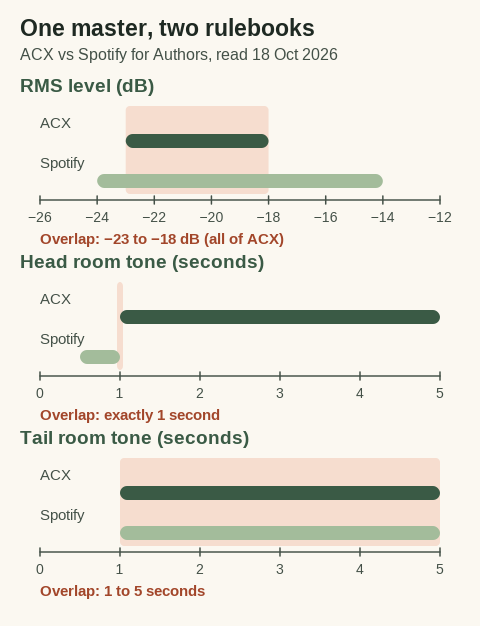
Ranges from ACX's requirements (revised 15 Apr 2026) and the Spotify for Authors guide (11/2024), both read 18 Oct 2026.
One master that passes all of them
If you're going wide, don't make store-specific versions. Make one set of files to the strictest number on each line, and every store above takes them:
- RMS between −23 and −18 dB per file (ACX's window; inside Spotify's).
- Peaks no higher than −3 dB. A limiter as the last step, set a little below that, keeps every file honest.
- Noise floor below −60 dB RMS, with margin, measured on your actual room tone. This is the line home narrators fail most often; our noise-floor page explains what it asks of a room.
- Exactly 1 second of room tone at the head and 2 to 3 seconds at the tail. One second sits at the shared edge of both head windows, so trim it precisely rather than by eye.
- Mono, MP3, CBR, 192 kbps, 44.1 kHz. That meets ACX and Spotify, and Google's 128 kbps floor for mono. If the book is stereo, export at 256 kbps CBR: Google's stereo floor, and a rate ACX lists as accepted.
- One chapter per file, nothing over 120 minutes, each file opening with its spoken header.
Spotify's guide also suggests naming files as "{ISBN}_{track number}.mp3" for ordering, and Google recommends "ID_XofY" for bulk uploads. Filenames are the one thing you may need to change per store; the audio itself doesn't.
Measure before you upload
Every number on the master list is checkable at home before a single upload. The free route is the one on our measurement page: the ACX Check analyzer in Audacity reads peak, RMS and floor for a selection. It's a Nyquist plugin, and Audacity's 4.0 release notes (September 2026) list Nyquist among the supported plugin formats while warning that some analyzers are still missing from 4.0, so check that it actually opens in your copy before any deadline. Remember what no meter checks: the length of your room tone and your export settings. Look at both yourself.
Then do the listened half. Both ACX and Spotify name mouth noise in their quality lists, and no RMS meter will find it. A full chapter on closed headphones, at a slightly raised volume, is the only test that catches it; our Booth Log entry on returned files explains why the meter misses so much.
Edge cases
- Your files were made for ACX years ago. Check the head room tone. Files cut to 0.5 seconds pass Spotify's guide but not today's ACX page; files with 3 seconds pass ACX but not Spotify's 0.5 to 1.
- A loud genre master. Spotify's window runs up to −14 dB RMS. Tempting, but it puts you outside ACX's −18 ceiling. Stay at −18 or below if Audible is in the plan.
- WAV delivery. Spotify and Google take 16-bit, 44.1 kHz WAV; ACX asks for MP3. Keep a WAV archive and export the MP3 from it.
- AI narration. ACX requires human narration unless it has authorized otherwise. Check each store's narration policy before you plan around a synthetic voice.
Spec questions, answered
- What are Findaway Voices' audio requirements now?
- Findaway Voices is now Spotify for Authors. Its guide lists RMS between −24 and −14 dB, a noise floor under −60 dB, 0.5–1 second of head room tone and 1–5 seconds at the tail, and MP3 at 192 kbps or higher (WAV and FLAC also accepted).
- Can one master pass ACX and Spotify?
- Yes. Master to ACX's tighter numbers (RMS −23 to −18, peaks at or under −3 dB, floor under −60) and use exactly one second of head room tone, the only length both head ranges allow.
- What does Google Play Books require for audiobook audio?
- Formats and bitrates rather than loudness: MP3 or AAC with CBR preferred (at least 128 kbps mono or 256 kbps stereo), or 16-bit FLAC or WAV at 44.1 kHz or above, and a total length between 5 minutes and 100 hours.
- Is the ACX room tone 0.5 seconds or 1 second?
- ACX's page, revised 15 April 2026, says 1 to 5 seconds at both the beginning and end, never over 5. The 0.5-second figure is the bottom of Spotify for Authors' head-tone range.
- Do I need a different master for Kobo?
- We couldn't verify Kobo's own audio specs on 18 October 2026, so we won't guess. Read Kobo's help pages before uploading; an ACX-compliant master is a sensible starting point to compare against.