Voice-over & audiobook · home recording
Know your floor. The rest is software.
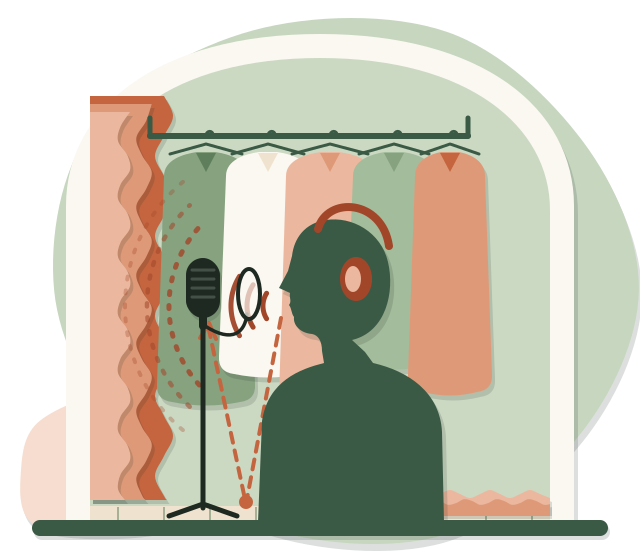
BoothSense is noise help for narrators and voice actors recording at home: measure the noise floor, fix it in the right order, pass the spec that pays you.
The premise, in three sentences
Every home voice-over problem that sounds like “my recordings aren't clean enough” is really a number: the noise floor, the level your room prints when you say nothing. ACX — the gate most audiobook work passes through — puts that number in writing: your floor must sit below −60 dB RMS, alongside RMS between −23 and −18 dB and peaks under −3 dB (verified against ACX's published requirements on 2026-09-20). Once the problem is a number, it stops being a mood and becomes a workflow: measure, treat what settings can treat, clean what software can clean, and re-measure until the meter agrees.
What we are not: a gear site, a room-treatment site, or an editing school. One physical truth, stated once — soft mass between your voice and hard surfaces beats any plugin applied after the fact — and that is the last you'll hear from us about rooms. Our beat is the measurement and the software.
- Measure
- Treat what settings can treat
- Clean what software can clean
- Re-measure
…and round again, until the meter agrees
-
 Start here
Home voice-over noise: the fix order
The six-step order of operations that keeps you from buying a solution to a problem you haven't measured.
-
 The gate
ACX audio requirements, verified
Every current spec — RMS, peaks, floor, room tone, file format — pulled from ACX's own help pages and dated.
-
 The number
What −60 dB RMS really means
Why the floor is measured in RMS, what a real spare-room floor looks like, and why passing isn't the same as clean.
-
 Ten minutes
Measure your noise floor, free
Record silence, read the meter, know your number — with Audacity and a free analysis plugin. Costs nothing, pays us nothing.
-
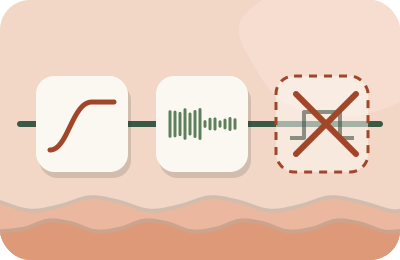 The chain
The home VO software chain
Measure → treat via settings → clean via software, and the order inside the chain itself: filter, then reduce, then never gate to silence.
-
 Bookings
Audition & self-tape audio
Casting decides in seconds. What your first five seconds say about your room, and the quick-turn cleanup that doesn't sound cleaned.
Why measurement-first, not plugin-first
Because the plugin-first route is how narrators end up with processed-sounding auditions and returned audiobooks. A noise reducer can subtract a steady hiss beautifully; it cannot tell you that the hiss was your interface gain cranked past where it needed to be — a gain-staging mistake that costs nothing to fix at the source. It cannot tell you the low thrum under your reads is the refrigerator two walls away, audible only between 2 p.m. and 4 p.m. It can only smear software over whatever arrives. Measure first and each fix lands on the actual cause; you use less processing, and less processing is the entire secret of audio that sounds like a person in a quiet room rather than a person inside an algorithm.
The same logic decides which software. Real-time suppressors like Krisp earn their keep on the live half of the job — directed sessions, agent calls, callbacks — where a barking dog can't be re-taken. Your recorded masters deserve the gentler, offline half of the toolbox. Different problems, different tools, one measured workflow. When your floor refuses to come down, diagnose the source before you fix anything — hiss, hum, and rumble each point somewhere different.
Questions people arrive with
- Can I really pass ACX without a booth?
- Yes — narrators do it constantly. The spec doesn't ask for a booth; it asks for a noise floor below −60 dB RMS and audio free of extra sounds. A quiet hour, sane gain, close mic technique, and a light software chain reach that number in most ordinary rooms. The path is laid out in the fix order.
- What's the one number I should know about my room?
- Your noise floor at your working gain, in dB RMS. Not a phone app's guess in dB SPL — the number your actual mic and interface print into your actual recordings. Ten minutes and free software gets it.
- Do you review microphones?
- No. Hardware is a different craft and other people do it well. We cover what happens after the mic: levels, measurement, software, and the specs your files must pass.
- Is this site trying to sell me something?
- Sometimes — transparently. A few links are affiliate links (marked, disclosed, routed through
/go/), and our most-repeated recommendation is a free plugin that pays us nothing. Details in the fine print.